SACRED GEOMETRY TATTOOS
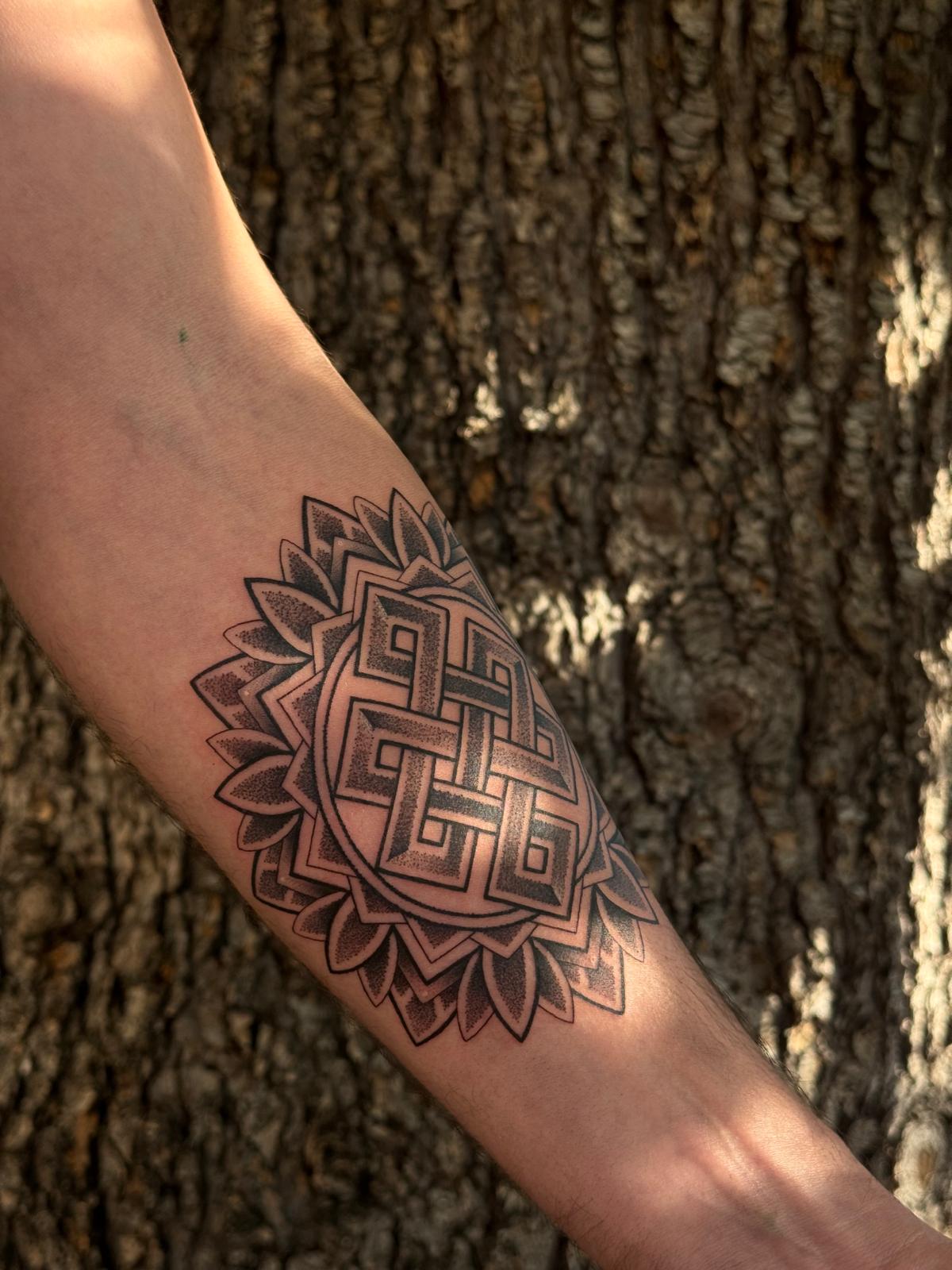
Sacred geometry is the oldest visual language we have. The flower of life, metatron's cube, the seed of life, the endless knot — these patterns turn up independently in Egyptian temples, Gothic cathedrals and Tibetan thangkas, because they describe how structure repeats at every scale. I tattoo them because they reward precision: get one intersection wrong and the whole grid reads as wrong, even to someone who couldn't tell you why.
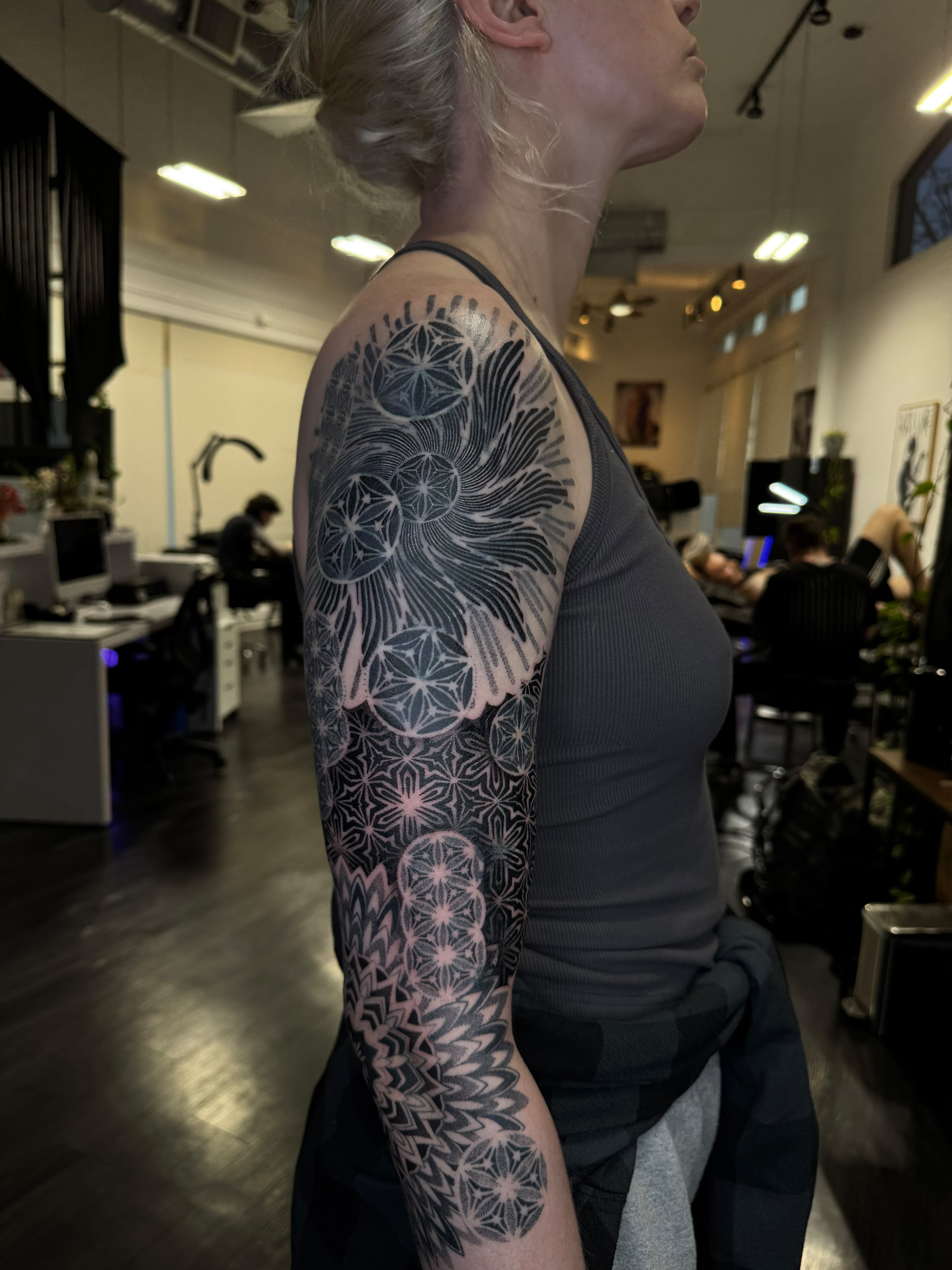
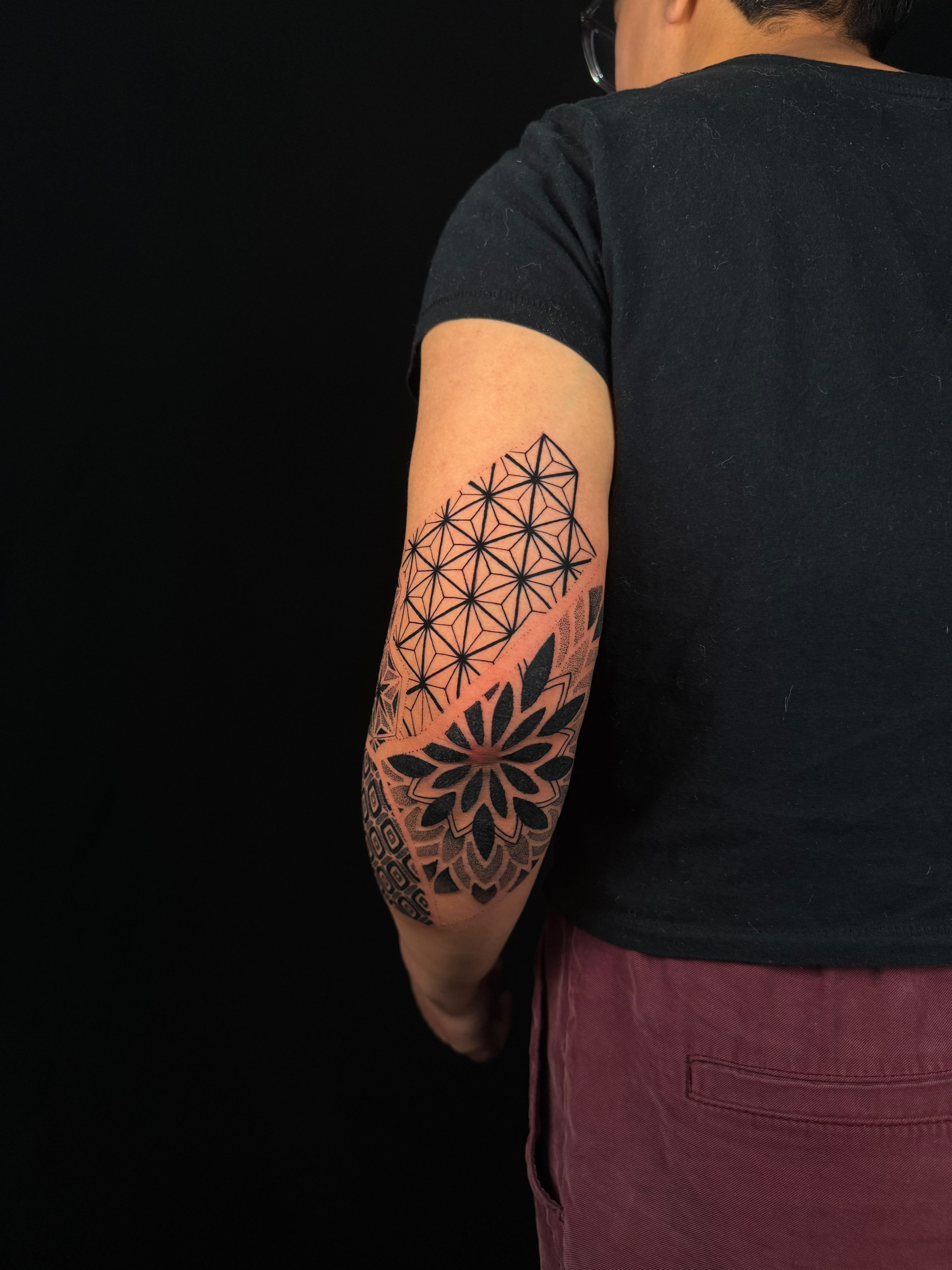
My approach starts with the body rather than the drawing. A flower of life laid flat on paper is a grid of even circles; laid across a shoulder or a ribcage it has to distort, or it looks distorted. I map the grid to the anatomy first, then build the pattern into it, so the geometry stays true when you move.
Most of my sacred geometry work is shaded in dotwork rather than solid black. Stippling lets a pattern hold its structure while still having depth — the linework stays crisp, and the shading sits behind it instead of competing with it.
How I build a sacred geometry piece
**We start with the placement, not the design.** Where a piece sits determines what geometry will work. A forearm can carry a single centred mandala; a full sleeve needs a grid that resolves at the shoulder and the wrist.
**I draw to your body.** Stencils are built and adjusted on the day, on you, not sent as a flat drawing in advance. Sacred geometry is unforgiving about symmetry, and symmetry on a limb is not symmetry on paper.
**Linework first, shading after.** On larger pieces the structure goes in across one or more sessions before any stippling starts, so the composition is locked before time goes into shading it.

SACRED GEOMETRY


What makes sacred geometry different from other geometric tattoos?
Sacred geometry uses specific traditional patterns — the flower of life, metatron's cube, the seed of life, the endless knot — that carry meaning beyond decoration. Geometric tattooing more broadly is any design built on geometric structure. In practice the difference is that sacred geometry has rules about how the pattern is constructed, and those rules are visible when they're broken.
Will the pattern stay symmetrical as my body changes?
The grid is mapped to your anatomy rather than laid flat over it, which is what keeps it reading correctly when you move. Ordinary weight change over years won't distort a well-placed piece noticeably. Large, rapid changes in a placement like the stomach or upper arm can, which is worth discussing before we start if it's relevant.
How fine can the linework go before it stops holding up?
Fine linework holds well on placements with less friction and stretch — outer forearm, back, thigh. On hands, feet and inner wrist, very fine lines blur faster. I'll tell you at the consultation if a design needs to be scaled up or simplified for the placement you want.
Can you design something around a specific meaning or intention?
Yes. Most sacred geometry pieces I do start from something the client wants the piece to hold, and the pattern gets chosen and built around that rather than picked off a wall.